Sunday, March 8, 2015

Ben-Hur


Ben-Hur
Chelsea, Jesse, Phil
Ben_hur_1959_poster.jpg


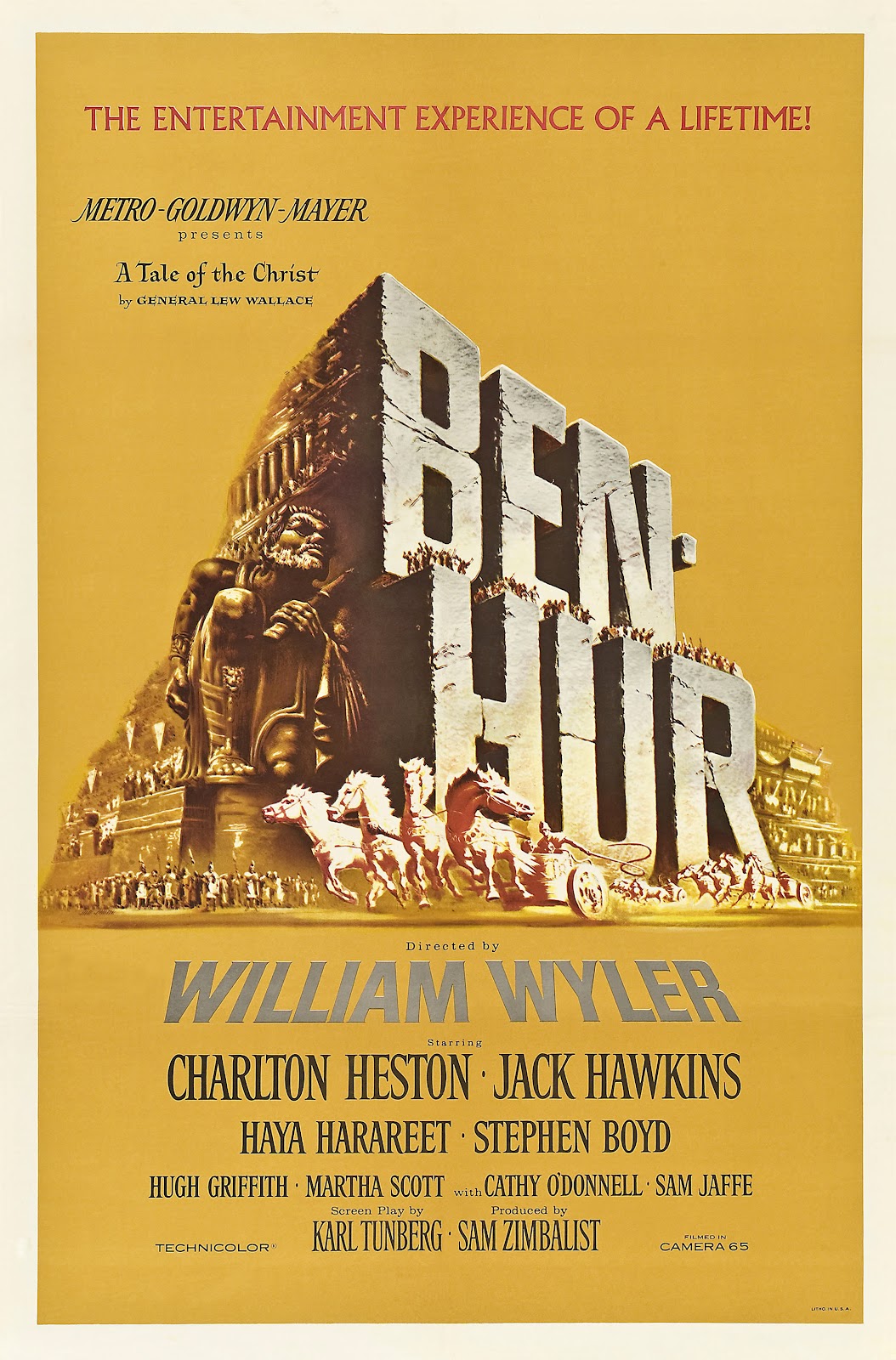
The 212-minute Biblical epic Ben-Hur (1959) was the most expensive film made up to that point, with a budget of $15 million. MGM gambled on the expensive film, which eventually saved them from bankruptcy, trying to capitalize on the success of The Ten Commandments (1956) and reprise Charlton Heston as a Moses-figure. The film grossed $147 million on its initial release, making it the second highest-grossing film at that time. The nine-minute chariot race sequence is still revered as one of the most technically impressive film scenes of all time; the scene is also a testament to the amount of work that went into the film, requiring an eighteen-acre lot, $1 million, a year of pre-production work, and five weeks of shooting. Winning 11 of the 12 Academy Awards it was nominated for, Ben-Hur remains one of the most successful films of all time. Over the course of the film, Prince Judah Ben-Hur of Judea grows angry with his childhood friend Messala, now a Roman garrison commander, who tries to use Judah to put down the Jewish religious rebellion beginning in Judea. When Judah chooses his people over Messala, Messala becomes vindictive and imprisons Judah, his sister Tirzah and their mother Miriam, for trying to kill a Roman guard when he knew the situation was an accident. Messala condemns Judah to life rowing in the galleys of a ship so that he will be seen as ruthless; however, when the enemy rams the ship, Judah saves the new commander after he went overboard. As repayment, the commander, Quintus Arius, adopts Judah as his son, giving him his name and inheritance. Now that he is free and rich again, Judah returns to Judea to enact his sworn revenge on Messala and to discover the fates of his sister and mother. Judah is told his mother and sister are dead, but after defeating Messala in the epic chariot race, Messala on his deathbed tells Judah that Tirzah and Miriam are alive in the Valley of the Lepers. After finally being persuaded by his love interest and former slave Esther who attended Jesus’s Sermon on the Mount, Judah tries to bring Tirzah and Miriam to see Jesus but they arrive as Jesus is carrying his cross to the spot of his crucifixion. When Jesus falls, Judah tries to give him water, the same way Jesus had when Judah fell in the desert on his march to his ship. When Jesus dies, a great storm comes, bringing life to the desert, curing Tirzah and Miriam of their leprosy, and Judah of his desire for revenge by killing Pontius Pilate, the new Governor, who had offered Judah Roman citizenship following his victory in the chariot race, which Judah had found disgusting.

This movie has two topics that it mainly focuses on.  The first of the topics dealt with is conformity.  Through out the movie Judah finds himself being constantly being pressured into accepting Roman culture over his Jewish heritage.  This is similar to and it was believed to be commentating on how conforming to the ideals of American society was strongly encouraged during the decade leading up to the release of the film.  The second topic is the necessity of faith to save yourself.  This topics presents itself in multiple instances throughout the course of the movie; several examples include when Christ gives Judah water while he is heading to the galleys, or when Judah's family is cured of their leprosy through Judah's faith in God and Christ.  This trend of necessity of faith is a core ideal of what America was during the Cold War, and the active encouragement of the faith we observe during the film.

The film Ben-Hur relates to the Cold War through several ideologies.  Throughout the movie, a resistance to the conformity of Rome is strongly promoted, a parallel to the American people's own resistance to the conformity of the Soviet Union.  Judah Ben-Hur argues on behalf of his people for religious freedom, a cause that hits close to home for any American.  The film also shames some elements of McCarthyism from the previous decade.  When Masala demands the names of the Jewish patriots, Judah resists and this is shown to be a heroic action on his part.  The film goes on to showcase ideas also supported in the books The Ugly American and The Spiritual-Industrial Complex.  These readings argue that religion and Communism are mutually exclusive, and that the best way to defeat the Communist threat is through faith.  Finally, we asked the class if they think that America remains religiously focused and whether or not such a film could push America to return to such a religious bend.  The class seemed to agree that America was not nearly as religious as it once was, and that it would be less impacted by such a film now as the morals were less powerful in our society as they once were.

Sources


Thursday, March 5, 2015

South Pacific

South Pacific
Rachel, Olivia, and Julia
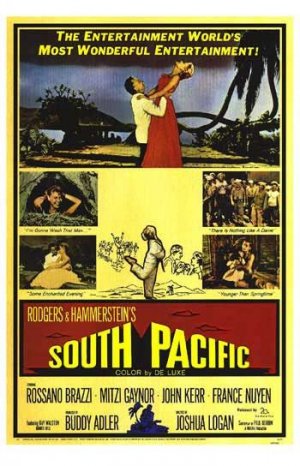
Rodgers and Hammerstein’s South Pacific was directed by Joshua Logan and released on March 19, 1958. Set on a US Navy base in the South Pacific islands, the musical follows Navy nurse Nellie Forbush, played by Mitzi Gaynor, in her struggles to accept the interracial marriage of the man she is in love with, Frenchman Emile de Becque, played by Rossano Brazzi. Nellie must also deal with the disapproval she is met with from the other nurses for being with an older, foreign man who had to flee his homeland for killing a man. Meanwhile US Marine Lt. Joe Cable is on a secret mission to get behind enemy lines in order to radio information back to the Navy. Cable deals with romantic issues of his own as he falls in love with the daughter of the mysterious Bloody Mary, played by Juanita Hall from the musical’s original cast. The film had an estimated budget of about 6 million dollars and grossed about $36,800,000. Logan’s main regret was the use of color filters due to his fear that the tropical landscapes of Hawaii would not translate well into Technicolor. Logan stated that this was the biggest mistake he made in his career.
There are two main themes that can be interpreted from South Pacific. The first is the issue of racism. The film tries to expose American racism towards Asians but is in some ways accidentally racist. Cable has a problem marrying Liat because she is Polynesian. Nellie almost has more of a problem with the fact that de Becque has a Polynesian ex wife then she does with the fact that he killed a man. In the song "You must be carefully taught" Cable explains why he and Nellie feel how they do. In the end Nellie overcomes her racism and is going to be a mother of an interracial family. The second theme is sex and gender roles. The gender roles that are seen in the film are very similar to what we have talked about in class so far. Women are very feminine. They dress to accentuate their feminine features and hold "female" jobs (e.g. nurses). Nellie also went to work during the war and gave up her job to be a mother and wife. The men are depicted very masculine and are the ones in control.
Throughout the movie there were many connections to the classic 1950’s lifestyle we have been discussing in class. In the very beginning of the movie, we see the lifestyle of the soldiers as a very homosocial environment and this was one of the main concerns for men during this decade.  Another point would be that the women in this movie are always dressed to perfection. Their outfits are incredibly feminine and when Nellie found herself “inappropriately dressed” she apologized to the men for not being dressed up in front of them. Nellie believes she is in love with Emile and she doesn’t want to tell her girlfriends because being in love with a man was an unrealistic ideal in the 1950’s. Marriage is shown to be a business deal through both Nellie and Lieutenant Cable. Lieutenant Cable mentions that a women is waiting to marry him in Philadelphia so he can get a good business deal with his uncle, so this means he won’t marry the love of his life. One of my last points was about how Asians were treated in this movie. They were seen as native, but gentle people, however neither Nellie nor Cable wants an interracial family. Interracial families were not accepted in that society. The question we asked the class was “how would the society at the time take and interracial marriage?” The class discussed how racism was both at its peak and at its end at this time. It was said that this movie was both making fun of racism purposefully, but also there were parts of the movie that were racist by accident which shows the conflicting views during the 1950’s.

Works Cited
"South Pacific." Questia. N.p., n.d. Web. 5 Mar. 2015. <https://www.questia.com/magazine/1G1-19658857/south-pacific>.

Friday, February 27, 2015

Blackboard Jungle


Blackboard Jungle (1955)


Bryan Keefer, Savanna Melton, & Holland Millure
            The movie Blackboard Jungle is a social commentary produced in 1955 that became a blockbuster hit of the year. This movie focused on the growing problem of teenage delinquency, especially in inner city schools. It concentrations on a new teacher in an all-boys school that has a terrible reputation for gang crime and misbehavior among the students. Blackboard Jungle tackles issues such as the delinquency problem as well as race, the generation gap post WW11, and more controversial issues such as miscarriage. The movie uses the context of the school to address all of these issues and directs their message to both adults (parents) and teenagers through different mediums, such as the music used and topics handled. Through the development of the plot and the interactions between the characters (teachers and students) the movie makes it clear that adults need to be committed to helping these teens to deal with all of these problems. The movie was received well by both adults and teens, but many feared that the problems talked about were more widespread than just in inner city school systems. Some cities found this movie to be too controversial, either refusing to show it or cut certain scenes that had the rock music played because they feared it would incite violence among teens after seeing the movie.
The main purpose of Blackboard Jungle is to inform and shock the public about the problems of juvenile delinquency and America’s failing public schools. Apart from the fact that the students are portrayed as criminals, they also appear disrespectful to adults and unmotivated in school. North Manual High School is an urban multiethnic vocational school, and the problems the school faced are mentioned and implied on many occasions. The film also reflects issues due to the generation gap. The teachers often discuss how they do not understand and cannot control the students, while the students constantly victimize the older generation. The film also puts on display the norm of rock ‘n’ roll, the music genre that was gaining significant popularity at the time, particularly among the younger generation. Teenagers danced in the aisles of the theaters as “Rock Around the Clock” by Bill Haley and His Comets played in the opening and closing credits, leading some theaters to mute the song. Blackboard Jungle is known for marking the emergence of rock ‘n’ roll in mainstream culture. One can definitely see the film as realist, as it depicts the actual problems many American schools were facing in the postwar era, but, on the other hand, it can be interpreted as a sensationalist exaggeration of the school problems and the overall danger of the newly emerging youth culture.
Unlike other movies we have reviewed Blackboard Jungle was a social commentary and so it directly addressed the issues it saw in society without the use of analogies like other films, such as Invasion of the Body Snatchers. One similarity, however, is the gender role conformity that’s seen through Mrs. Dadier, being a “perfect wife” like the mother in “Leave it to Beaver!,” as well as through Mrs. Hammond, who is condemned for her promiscuity like the gypsy in Oklahoma!. Other connections are with respect to the article, “Yakety Yak, Don’t Talk Back.” Problems brought up that are addressed in the movie include the generation gap, inner city communities, concerns with rock ‘n’ roll and for a correct way to discipline teenagers. The main article and the movie mostly focus on the influences of rock ‘n’ roll to have teenagers reject adult authority and the correct way to discipline. The movie “demonstrates” the fears addressed in the article that rock ‘n’ roll does cause teenagers to rebel against authority, including teachers, conform to peer-norms (of gang violence in this case), and become hypersexual while and after listening. The movie also addresses with the difficulties of disciplining and getting the correct response needed from the teenagers after the punishment has been given.

Sources
Bosley Crowther, “The Screen; ‘Blackboard Jungle’; Delinquency Shown in Powerful Film,” New York Times, March 21, 1955, accessed February 25, 2015, http://www.nytimes.com/movie/review?res=9803E1DE153EE53ABC4951DFB566838E649EDE.
“Blackboard Jungle,” http://en.wikipedia.org/wiki/Blackboard_Jungle.
Encyclopaedia Britannica Online, s.v. “Blackboard Jungle,” accessed February 25, 2015, http://academic.eb.com.pitt.idm.oclc.org/EBchecked/topic/1346766/Blackboard-Jungle.
Adam Golub, “They Turned a School into a Jungle! How the Blackboard Jungle Redefined the Education Crisis in Postwar America,” Film & History 39 (2009), accessed February 25, 2015, https://www.questia.com/read/1P3-1883667851/they-turned-a-school-into-a-jungle-how-the-blackboard.
Kevin E. McCarthy, “Juvenile Delinquency and Crime Theory in Blackboard Jungle,” The Journal of Criminal Justice and Popular Culture 14 (2007), accessed February 25, 2015, http://www.albany.edu/scj/jcjpc/vol14is4/McCarthy.pdf.


Tuesday, February 17, 2015

All That Heaven Allows


All That Heaven Allows

Jai-W Hayes-Jackson and Ryan Rabea


          The movie was directed by Douglas Sirk, written by Harry and Edna Lee, and produced by Universal Pictures. We could not find a budget for the film, but it did relatively well in the box office grossing 3.1 million dollars. It starred two huge actors in Rock Hudson and Jane Wyman as the main roles, with Jacqueline deWitt as the antagonist, Agnes Moorhead as the best friend, and Gloria Talbott and William Reynolds as Cary Scott’s children. The New York Times wrote “The script was obviously written to bring Wyman and Hudson, who made a popular twosome in The Magnificent Obsession, together again. Solid and emotional drama gave way to outright emotional bulldozing and a paving of easy clichés. Today it is received very well even being added to the National Film Registry in 1995. It is also quite surprising that the only controversy in this film was between the director and Universal on the ending. Hudson was a gay man and Sirk was a German born who made Marxist films, in a time when both of those would be heavily looked down upon.
          We discussed how Sirk was very paradigm breaking with this film, and against the norms of the day. He was against the oppression of the woman, and that was on display throughout the whole movie. He used the main character of Cary Scott to show that women have their own identity outside of a man, and they should be allowed to explore that through their own choices. He broke down normal gender roles. Rock Hudson’s character is very expressive of his feelings throughout the movie, he is the much less well-off of the duo, and he is willing to give up children to pursue love of an older woman. Cary Scott is rich, and very strong and independent in the film, opposite the norm for women. The film was non-consumerist in some of its messages. Consumerism was taking hold in the 50’s and 60’s. Many people valued themselves by their perfect suburban houses and new appliances. Cary Scott was willing to give up on her perfect house and move to the country side with a poorer man who couldn’t give her all that. She was even against buying herself a television. Also the movie was non-conformist and escapist. Sirk wanted a sad ending with Hudson dying to show the audience that if you conform to what society wants you will be miserable, but he was still able to put that message on display with how devastated Cary was after she called off the engagement with Ron.
          All That Heaven Allows challenges both gender roles of women and the consumerism around investing in a house. The protagonist, Cary Scott is viewed as a conventional women until she becomes engaged to a man who is less well off than she is. Enlightened that her reputation would be ruined, she still defies normalcy and continues with the relationship. It was atypical of women to care more about themselves than there reputation which Cary Scott seems to pioneer away from. We also see the effects of consumerism in the movie with the house representing the ideal American home. The same house from Leave it to Beaver, we see that there was a stigma that revolved around what an American family should strive to embody, especially through consumerism products such as televisions and cars. All That Heaven Allows is also brings up the question of why a relationship that was abnormal, was otherwise disapproved of. After discussing possibilities, it was majorly agreed on that gender roles was very strict and rigid and that anything outside of these norms was mostly frowned upon. With that being said, Cary Scott’s relationship was no different.


http://heylookmeover.blogspot.com/2008/11/film-data-for-1955.html


Thursday, February 12, 2015

Leave It to Beaver

Leave It to Beaver (1957-1963)
Ellen Foley, Catherine Walsh, & Kevin Boylan


Leave it to Beaver was an American sitcom produced by Joe Connelly and Bob Mosher that premiered in October 1957 (incidentally the same day Sputnik launched). The show was broadcast by ABC and subsequently by CBS as 30 minute, black and white episodes. The show was well reverted by a wide audience, though not as popular as its contemporaries. This came as no surprise, as the shallow, rosy characters provided no controversy. Leave It to Beaver was selected to be one of Time's magazines "best 100 shows of all time," and had a brief revival with the same cast in 1983. The cast featured Barbra billingsly as June, Hugh Beaumont as Ward, Tony Dow as Wally, and Jerry Mathers as Beaver. Each episode featured some version of "bad behavior" by the children and displayed parenting techniques to deal with this unique to each situation in the episode.
The main themes of this long-running TV sitcom fit perfectly into the 1950s mold of the ideal American life. Traditional gender roles in a nuclear family is a major part of the characters’ identities. June Cleaver is the perfect housewife: she dresses nicely while cooking, cleaning, and taking care of the house while Ward goes to work and the kids head to school each day. She loves her husband and sons, and concerns herself with their looks and cleanliness, often leaving the important teaching moments to Ward. He is the main disciplinarian in the house, as any 1950s father would be expected to be. His main role is as a father, not a working man, and little is given away about his work life. This nuclear family life is also very secure and safe, clearly displaying the mentality that there is security and happiness in domesticity. Political and international issues that plagued the world at the time are never mentioned; the show is an escape from the more dangerous realities of the world outside of domestic tranquility. Morality is another important theme in the sitcom, and there is a constant string of lessons being taught to viewers as Ward teaches Beaver. This emphasis on raising children right once again shows the focus on family life and the importance of passing on lessons of morality to the next generation. 
            We can connect Leave it to Beaver to our class reading “Homeward Bound”. The show represents the typical suburban life in the 1950’s. On the show we can see the typical suburban home with all the new appliances around the house. The family structure was strong between the parents and the children.The parents, June and Ward, have a very stable marriage. Ward goes to work while June takes care of the house work and the children. When Ward comes home from work June has dinner ready for the family. June is always dressed up nice with pearls and an apron. After dinner it is typical for Ward to read the newspaper. The show also always has a message for the children to learn when they do something wrong. The message is always taught by the father. This show connected to the audience so well because it showed everyday problems that young children might face. That is why the father was always telling the children the right thing to do.

Sources
http://en.wikipedia.org/wiki/Leave_It_to_Beaver
http://web.wm.edu/americanstudies/370/2001/sp2/leave%20it%20to%20beaver.html

Tuesday, February 10, 2015

Oklahoma!

Oklahoma! (1955)
url.jpg
The film Oklahoma! was released in 1955, but was based off the Pulitzer Prize winning play of the same name, written by Lynn Riggs and Oscar Hammerstein. Oklahoma! was directed by Fred Zimmerman, produced by Arthur Hornblow Jr., and written by Sonya Levien and William Ludwig. James Dean and Paul Newman actually tried out for the role of Curly but the part went to Gordon MacRae instead. In addition, Joanne Woodward was offered the role of Laurey, but it went to Shirley Jones who had performed in a stage production of Oklahoma!. The film was also the first feature film to be shot in the Todd-AO 70mm widescreen process as opposed to the usual 35mm format. The budget was around $6.8 million, made $7.1 million and was reviewed fairly well resulting in a “New York Times Critics Pick.” The film was also nominated for 4 Academy Awards and won the awards for Best Music Scoring of a Musical Picture and Best Sound Recording. Lastly, Oklahoma! achieved the honor of being selected for preservation in the United States National Film Registry by the Library of Congress as being culturally, historically or aesthetically significant.  
The plot centers on a cowboy named Curly and his courtship of Laurey, a farm gal. Curly wants to take Laurey to the box social but she already agreed to go with the menacing farm hand, Jud. There’s also a comical subplot of Ado Annie and her love triangle between a foreign peddler, Ali Hakim and Will parker who has arrived back from Kansas City to marry her. On the way to the box social, Laurey decides to leave Jud behind and go find Curly at the social. There at the social, Curly must win a bidding war against Jud for Laurey where he gives up all he owns to outbid Jud. Later on, Curly marries Laurey, but Jud shows up and attempts to kill them by setting the haystack they are on top of on fire. Curly jumps down to fight Jud, but Jud falls on his knife and dies. The next day, Curly is quickly acquitted of any wrongdoing in the death of Jud, and he and Laurey ride off to the train.
           The first main theme of Oklahoma! is the importance of traditional American family values.  This theme is explored through the characters of Laurie and Curly.  They spend the whole movie coming together, and in the end they become engaged, and Curly says that he is going to give up being a cowboy to settle down and start a family with Laurie.  Marriage is a major goal for all of the characters and this reflects the idea that young people should be settling down and getting married at a young age. The second message in the film is a mistrust of outsiders.  The character Jud Fry lives on the fringes of society, he does not own his own land, he’s a farmhand, and he does not have any family.   From the beginning of the film the main characters show a dislike for Jud, and in the end their dislike for him is vindicated when he tries to kill Curly and Laurie.  Another less sinister character that shows that outsiders should be mistrusted is Ali Hakim.  He is a gypsy peddler who takes advantage of women.  He uses women with  no intention of marrying them, which is the opposite of what a good American boy would do.
The film Oklahoma! marks a departure from the previous films viewed in class such as The Manchurian Candidate as it relates less to McCarthyism and Communism and more to the sentiments and values of 1950s Cold War America. The film relates to our class discussion, especially the novel, Homeward Bound in regards to themes such as traditional gender roles, emphasis on marriage and subsequent security established at a young age, and the value of female sexuality as seen in Ado Annie’s storyline. In the discussion of how Oklahoma!’s popularity reflects on 1950’s values, members such of the class such as Savannah, Amir, and Damon brought up good points. They said that the movie shows an emphasis on turning to a traditional home, “going back to the roots”, and a simple home life with less vulnerability. Also, they mentioned the movie reflects on the 1950s consumerism and focus on the family.

By: John Parker, Grace Gealy, Marissa Ferrighetto
Sources:
http://www.imdb.com/title/tt0048445/?ref_=tttr_tr_tt
Homeward Bound
Class notes and discussion